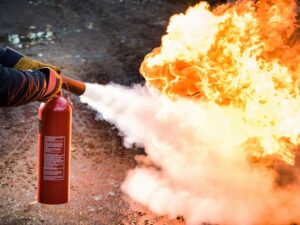

Health and Safety training comprises procedures, teachings, and methods intended to equip employees with the knowledge and skills needed to safely perform their jobs and maintain a secure work environment. The goal of this training is to minimise workplace accidents and illnesses, ensuring workers can carry out their roles effectively and safely.
Occupational Health and Safety Training (OHS) is a great way for employees to learn additional skills and knowledge, and to reinforce quality work practices, which will result in a change in workplace behaviour. Investing in effective employee training will increase skills, knowledge, productivity, and morale, and also avoid workplace incidents. Strat Training runs several training courses concentrating on occupational health and safety. These include Health and Safety Representative (Level 1), and Incident Investigation (Level 2).
Health and Safety Representative (Level 1)
The prime functions of the HWSETA-accredited Health and Safety Representative course is to identify hazards, be aware of all potential risks and hazards at the workplace and to ensure the continued health and safety of self and colleagues.
This course covers six modules: legal knowledge, the difference between occupational health and occupational safety, incident prevention, hazard identification, incident investigation, and conducting meetings.
These modules cover various concepts such as occupational hygiene, the measuring tools of safety, acceptable levels exposure, business elements, and identifying the spectrum of losses.
(Unit Standard: 259622 — NQF Level: 2 — Credits: 3)
Incident Investigation (Level 2)
The process of hazard and/or incident identification and risk assessment is taught to ensure that learners apply health and safety and environmental principles and procedures in the workplace. In this way they are equipped to contribute to a safer work environment, and can thus assist management in identifying potential hazards.
Topics that will be discussed cover principles of the OSHAct, definitions, and an understanding of the specific requirements pertaining to continuous hazard identification and risk assessment.
The course is designed to enable learners to meet minimum workplace standards, and to initiate and remedial actions.
This course is designed around four modules, covering topics like managing the scene of an emergency, basic human anatomy and physiology, and the primary and secondary survey.
(Unit Standard: 259617 — NQF Level: 2 — Credits: 3) — Conduct an investigation into workplace safety, health and environmental incidents
To find out more about these course, contact us.

